
How to Audit Your WordPress Site for SEO, Broken Links, and Image Issues
Most WordPress sites carry dozens of small SEO and accessibility issues their owners never see. A few missing meta titles here, a…
Read article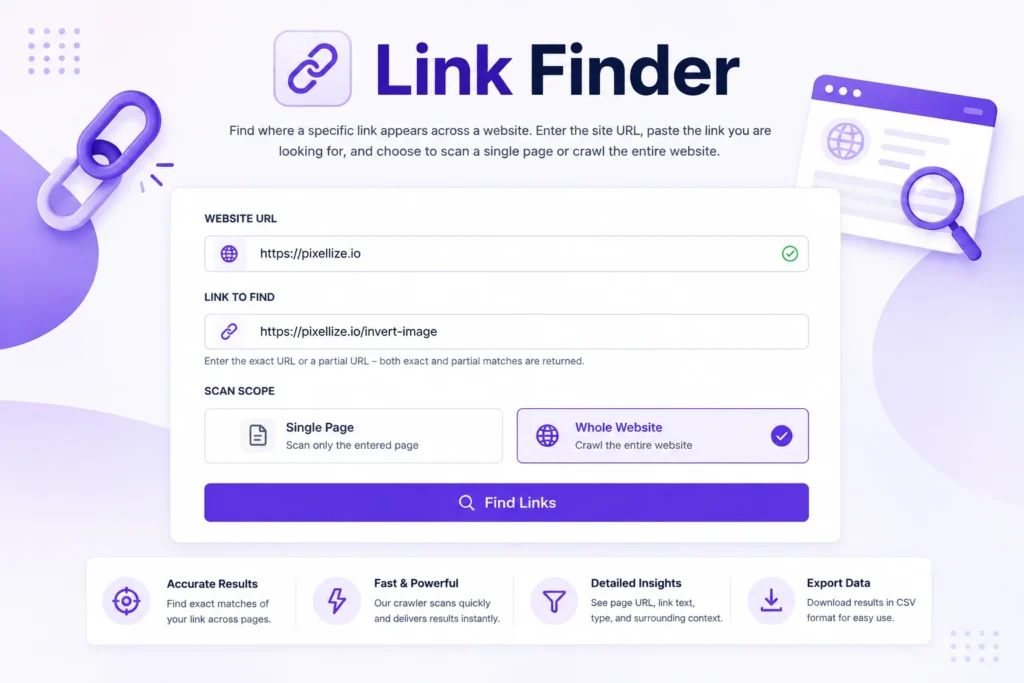
Copy any URL into the address bar on a site you don’t own and you see one page, nothing more. But every page on that site links to dozens of other pages, and finding all of them manually takes hours. Whether you’re auditing internal links, checking where an outdated URL still lives, or mapping a competitor’s site structure, you need a faster way to find all links on a website. The Pixellize Link Finder handles it without an install, but there are four other methods worth knowing depending on your situation.
This guide walks through all five, tells you when to use each, and ends with a comparison table so you can pick the right one in under 30 seconds.
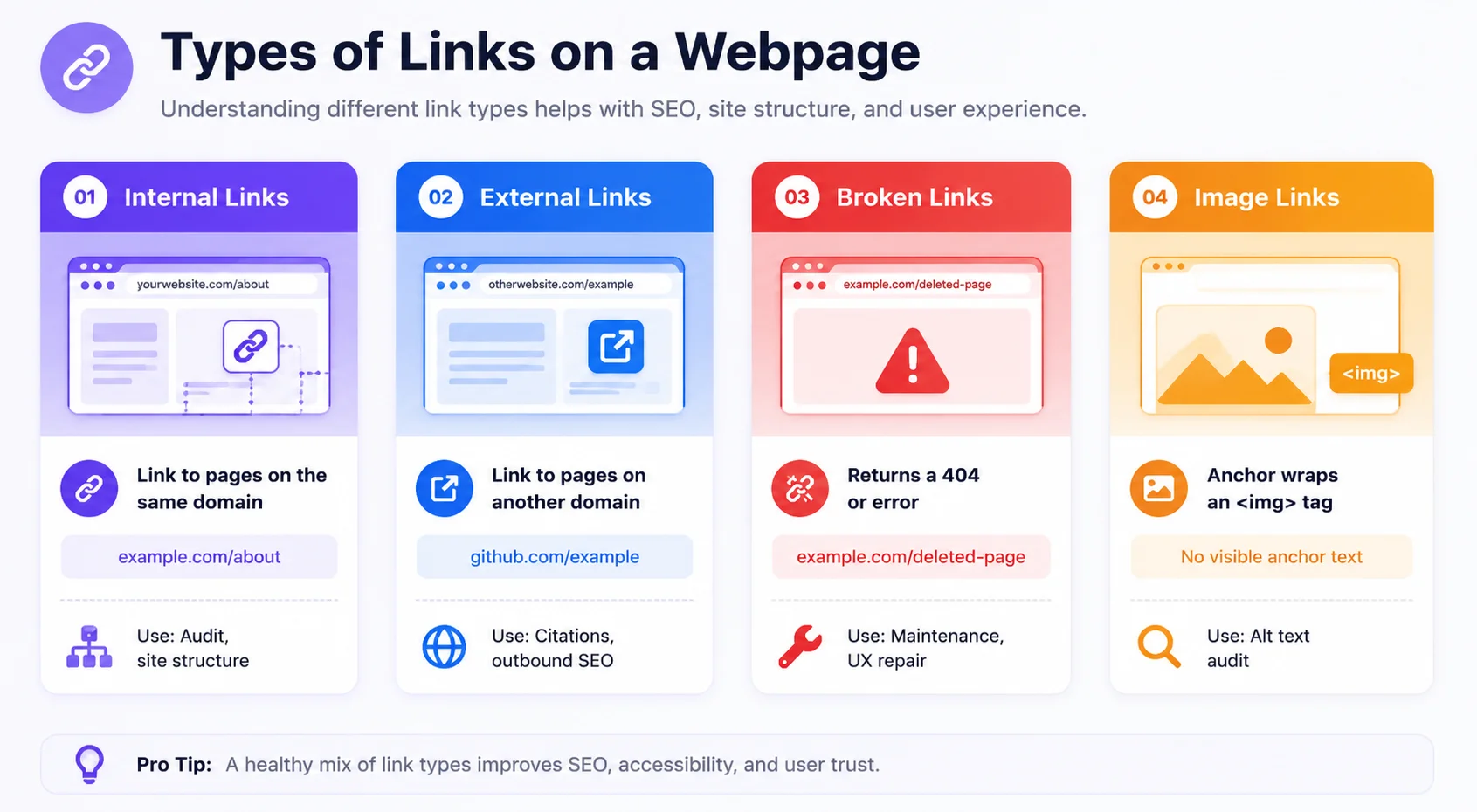
A link on a website is any anchor tag pointing to another URL. There are four types: internal links (same domain), external links (different domain), broken links (4xx/5xx errors), and image links (anchors with no visible text). Most link extraction tools return all four, though some skip anchor text and only report the raw href value.
Here’s the thing: most people searching for “all links on a website” actually want to know where a specific URL appears, not just a raw dump of every href. That’s a different job. A raw dump needs a crawler. Finding where one URL lives needs a search tool. Keep that distinction in mind when picking your method below.
The Pixellize Link Finder is the fastest way to find all links on a website without downloading anything. You enter the site URL, paste the specific link you’re searching for, pick “Single Page” or “Whole Website,” and the tool returns every matching page with the link’s anchor text, link type, and context. Whole-website mode crawls up to 2,000 pages automatically.
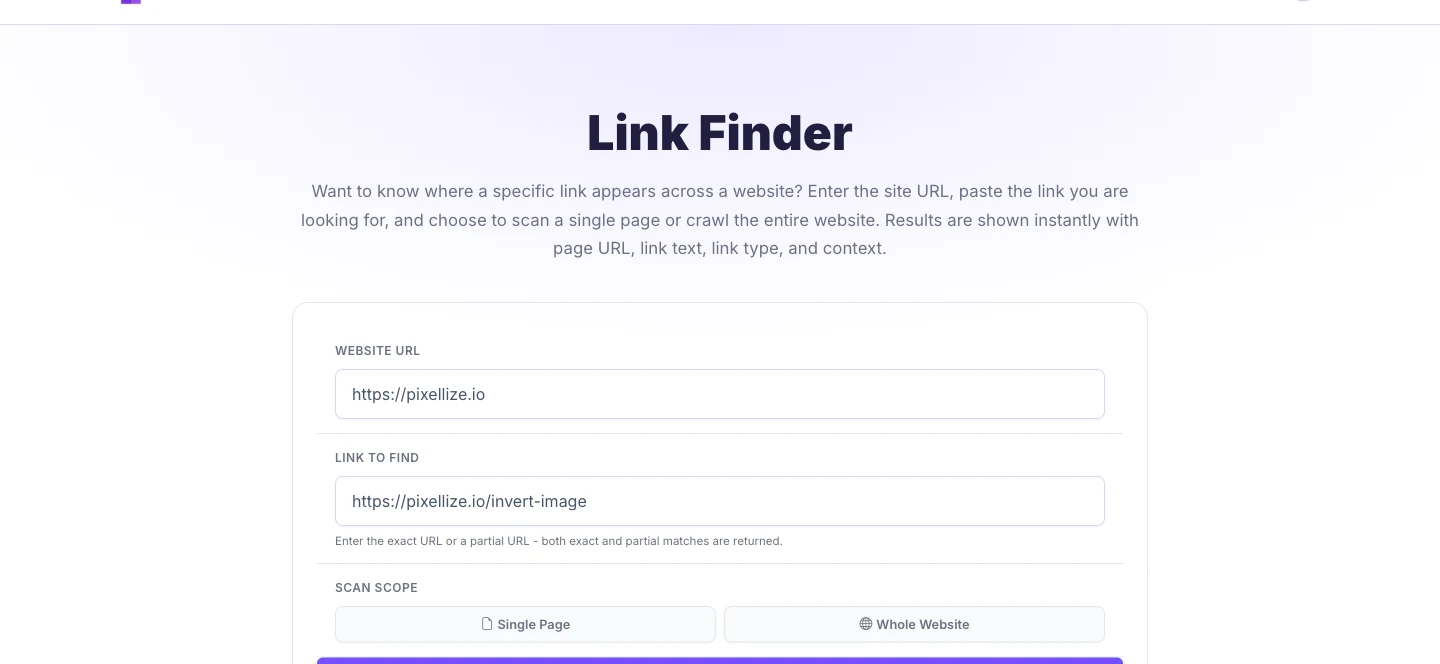
https://example.com.twitter.com returns all pages that link to any Twitter URL.Pixellize handles both exact and partial matches, which is useful when you want to audit all pages that link to an old domain you once used. The tool ignores trailing slashes, so example.com/page and example.com/page/ match the same result.
Every modern browser ships with a JavaScript console that can run a one-line query to extract all links from the current page. No install, no account. Open the console with F12 (Windows/Linux) or Cmd+Option+J (Mac), then paste this:
// List every href on the current page
[...document.querySelectorAll('a[href]')].map(a => a.href + ' | ' + a.innerText.trim()).join('
')
The output prints every absolute URL with its anchor text, separated by pipes. You can copy it straight to a spreadsheet. For internal links only, filter with .filter(a => a.hostname === location.hostname). For external links, flip the comparison.
The tradeoff: this works on the page currently loaded in your browser. It reads the live DOM, so JavaScript-rendered links are included, but you have to run it page by page. Usable for a quick audit of one URL, not a whole site.
Extensions like LinkMiner or Check My Links overlay the current page with link status indicators and let you export all hrefs with one click. They’re good for editors and content managers who want to check a page without opening dev tools. Keep in mind they only see what your browser renders, so they share the same single-page limitation as the console approach.
According to Chrome’s extension documentation, content-script extensions inject at page load and can query the DOM synchronously, which means they catch static links but may miss links injected by later async calls. For most standard websites, this is fine.
If you’re comfortable in Python, BeautifulSoup extracts every href from a page’s HTML in about 10 lines. Install the library with pip install requests beautifulsoup4, then:
import requests
from bs4 import BeautifulSoup

url = "https://example.com"
r = requests.get(url, timeout=10)
soup = BeautifulSoup(r.text, "html.parser")
links = [a['href'] for a in soup.find_all('a', href=True)]
print(f"{len(links)} links found")
for l in links:
    print(l)
The limitation: BeautifulSoup parses raw HTML. On sites that render links with JavaScript after the page loads, it misses them entirely. For those, you’d swap to Playwright or Selenium, which launch a real browser and execute JavaScript before extracting. That adds setup time but gets accurate results on modern React and Vue apps.
Python is the right choice when you need to process hundreds of pages, write results directly to a database, or chain link extraction into a larger scraping pipeline. For a one-off audit, the browser console or a Pixellize scan is faster.
HTTrack and wget are command-line tools that mirror websites locally, following every internal link they discover. Once the download completes, you can parse the local file tree for all hrefs using grep or any link parser. This is the slowest method but gives you the full site on disk.
# wget: mirror a site and extract all internal hrefs
wget --spider -r -nd --no-verbose -H -l 1 https://example.com 2>&1 | grep '^--' | awk '{print $3}'
Keep in mind wget does not execute JavaScript, so it misses dynamically-loaded links on modern single-page apps. HTTrack handles CSS and images well but has the same JavaScript gap. Use these tools when you specifically need a local copy of the site, not just a link list.
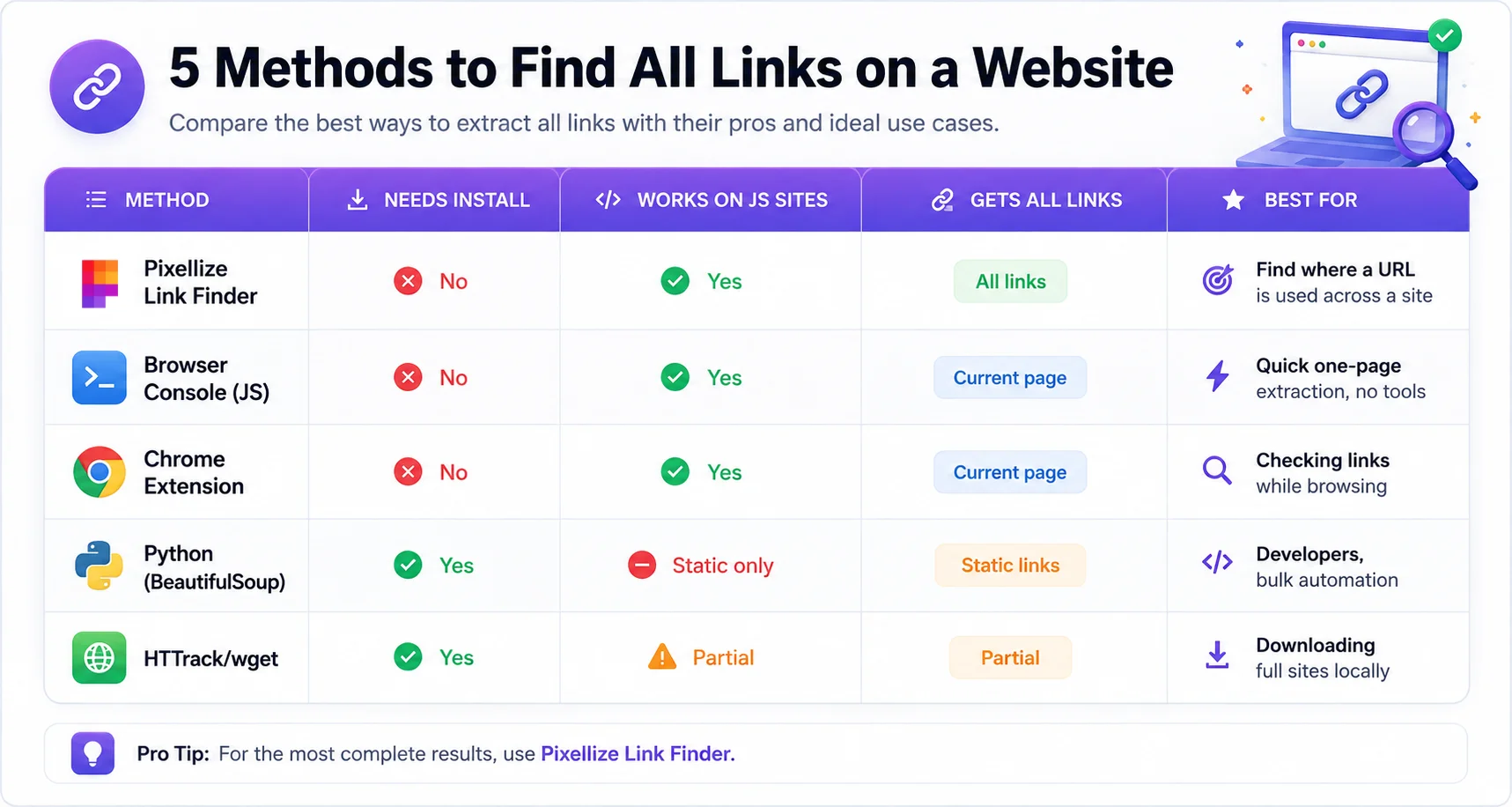
Pick based on scope. For a full-site audit without any install, the Pixellize Link Finder is the right tool: it crawls up to 2,000 pages and exports CSV or JSON. For a single-page spot check, the browser console takes 10 seconds. For automation across hundreds of pages, use Python. For an offline copy, use wget.
| Situation | Best method | Why |
|---|---|---|
| Find where a specific URL appears across a whole site | Pixellize Link Finder | Crawls up to 2,000 pages, partial match, CSV/JSON export, no install |
| Quick check of one page | Browser console (JS) | Zero setup, runs in seconds, works on any device |
| Checking links while browsing daily | Chrome extension | Passive, always-on, visual status overlay |
| Bulk extraction, hundreds of pages | Python + BeautifulSoup | Programmable, fast, integrates into pipelines |
| Need offline copy + link list | HTTrack / wget | Downloads full site, then grep for hrefs |
An SEO internal-link audit has 3 specific goals: find orphan pages (no inbound internal links), find pages with too many outbound links (diluted authority), and find broken links that need fixing. The Pixellize link extractor handles the first two directly. Enter your own domain as both the website URL and the search URL to map which pages link where. Broken links need a separate pass with the broken link checker.
For a full audit workflow: run Pixellize’s Link Finder on your domain to map internal link distribution, then cross-reference with your sitemap to spot pages that no internal link points to. According to Google’s crawling documentation, crawlers discover pages primarily through links, so orphan pages often don’t get indexed at all.
You don’t need to install software, write code, or create an account to find all links on a website. The Pixellize Link Finder crawls up to 2,000 pages, returns internal and external links with anchor text and context, and exports to CSV or JSON in one click. It works on any site, from any device, with no signup.
Open the free Pixellize Link Finder, paste the site URL and the link you’re looking for, and run the scan. For a full SEO audit, pair it with the broken link checker and the image sitemap generator to cover every crawl signal at once.
The fastest free way to find all links on a website is the Pixellize Link Finder. Enter the site URL and the link you are searching for, choose Whole Website, and the tool crawls up to 2,000 pages. Results show the page URL, anchor text, and link type. You can export everything as CSV or JSON. No account or install needed.
Open your browser developer tools with F12 (Windows) or Cmd+Option+J (Mac), then paste this into the console: [...document.querySelectorAll("a[href]")].map(a => a.href).join("n"). This returns every absolute URL on the current page. Add .filter(a => a.hostname === location.hostname) to limit to internal links only. The output can be copied directly into a spreadsheet.
Internal links point to pages on the same domain, for example example.com/about links to example.com/contact. External links point to a different domain, for example example.com/page links to twitter.com. Search engines use internal links to discover and index pages, and to understand how authority flows across a site. Pages with no internal links pointing to them are called orphan pages and are often not indexed.
Yes. The Pixellize Link Finder runs entirely in your browser and crawls up to 2,000 pages of any website without any software install or account. For a single page, the browser console method is another zero-install option that takes about 10 seconds. Chrome extensions like LinkMiner are also install-free if you count browser plugins, though they only work on one page at a time.
The Pixellize Link Finder crawls up to 2,000 pages per search. You can set your own limit between 1 and 2,000 in the Max Pages field. Crawling stops when it reaches your limit or when it runs out of internal links to follow, whichever comes first. For most small to medium sites, 2,000 pages covers the full site. Larger sites need a dedicated crawling tool like Screaming Frog.
Yes. Unlike BeautifulSoup or wget, the Pixellize Link Finder fetches pages through a server-side renderer that executes JavaScript before extracting links, so dynamically loaded navigation menus and lazy-loaded content are included in results. Python-based static HTML parsers like BeautifulSoup miss these links unless you add a browser automation layer like Playwright.

Founder and CEO of Pixellize.io, building AI-powered web tools and digital products with a focus on user experience and automation. M.Sc. Zoology, working at the intersection of technology, data analytics, and life sciences.