

Google AdSense rejected my site twice for “low value content”, and if you run a small or niche site, you may have hit the same wall. The good news is AdSense is not the only game in town, and some of the best Google AdSense alternatives are easier to get into and pay as well or better.
I run Pixellize, a site full of free browser tools, so I went looking for networks that approve sites like mine. Below are five worth your time, ranked by how easy they are to join in 2026, each with real requirements, honest pros and cons, and the exact steps to apply.
Why look beyond Google AdSense?
People leave AdSense for three reasons. It rejects a lot of sites, its approval bar keeps rising, and its revenue share is quietly one of the lower ones at roughly 68 percent to the publisher. For a new site, the first reason bites hardest, since you cannot earn a cent while you sit in review.
Here is the thing though. The alternatives are not all better, they are different. Some pay more but demand real traffic. Others approve you in a day but pay less per click. The trick is matching the network to where your site is right now, not chasing the highest number in a comparison post.
How ad networks pay, in plain terms
Before you compare networks, it helps to know how each one actually pays you, because the pricing model tells you what kind of traffic earns.
- CPM pays per 1,000 impressions, so you earn just for showing the ad. Most display networks, including Ezoic, Monumetric, and Mediavine, work this way.
- CPC pays per click. AdSense and Media.net lean on this, which rewards content that gets people clicking.
- CPA pays when a visitor completes an action, like a sign-up. Some Adsterra formats use it.
- Revenue share means the network keeps a percentage and pays you the rest. Ezoic, Mediavine, and Adsterra all run on a split.
The takeaway: CPM networks reward raw pageviews, CPC networks reward engaged clicks, and the managed revenue-share networks reward quality content that advertisers will pay a premium to sit beside. Match your traffic type to the model and the earnings start to make sense.
The 5 best Google AdSense alternatives at a glance
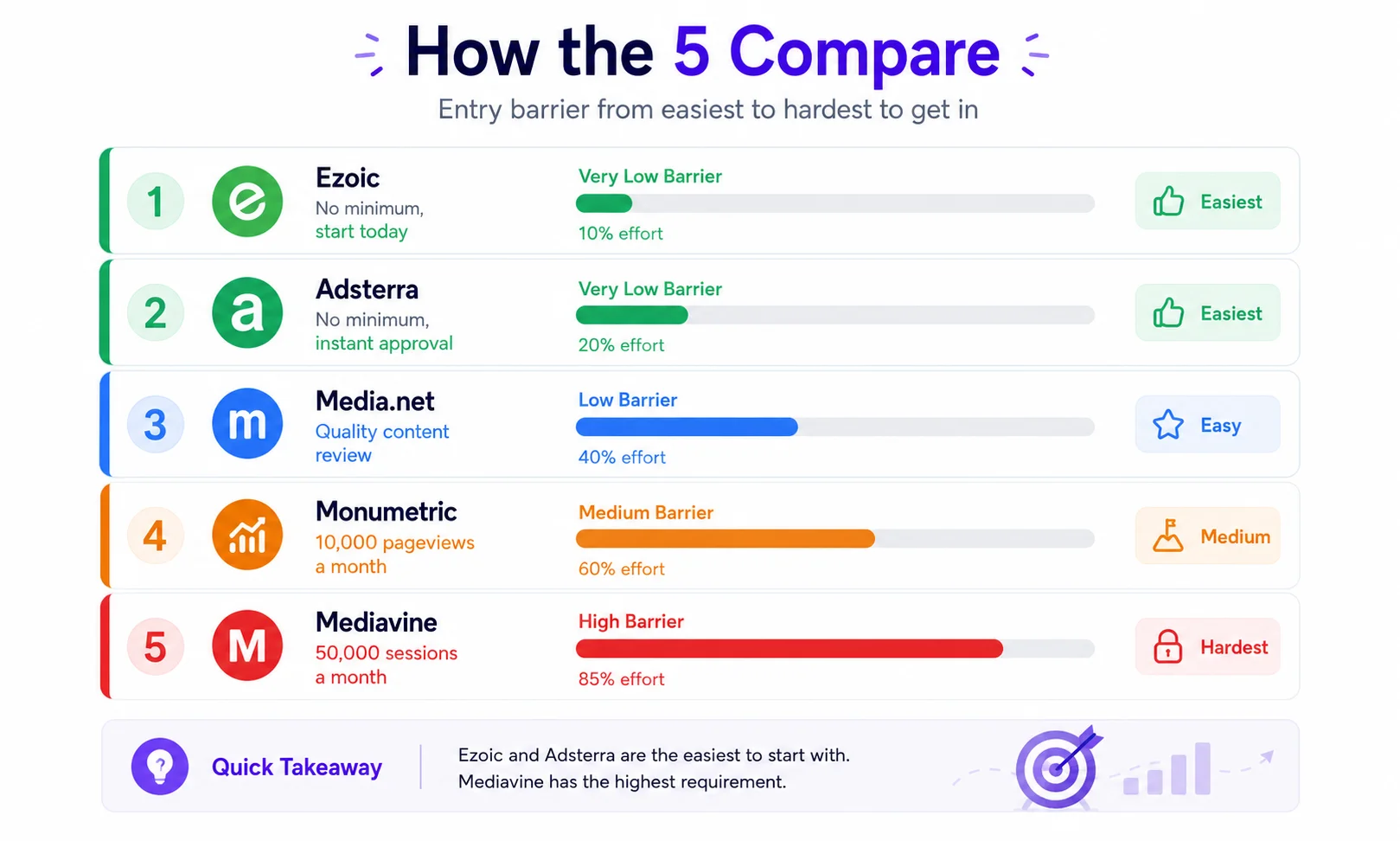
| Network | Entry requirement (2026) | Approval | Minimum payout |
|---|---|---|---|
| Adsterra | None | ~10 minutes | $5 crypto, $25 PayPal |
| Media.net | No hard minimum, quality review | A few days | $100 |
| Mediavine Journey | 1,000 sessions / mo | Manual review | Monthly (net-65) |
| Monumetric | 10,000 pageviews + $99 setup | A few weeks | Monthly (net-60) |
| Ezoic | 250,000 users, or the Incubator | Fast once verified | $20 |
1. Adsterra, the easiest to start with
Adsterra approves almost anyone, usually in about 10 minutes, with no traffic minimum. It is what I was running on Pixellize before I dug into the others. Ad formats include banners, native units, social bar, and popunders.
Adsterra pays on a mix of CPM, CPC, and CPA, so you earn on impressions, clicks, or completed actions depending on the format. That breadth is why it fills every slot, and why it suits global, high-volume, and entertainment traffic more than a quiet niche blog. Best for: new sites that want money flowing today while they build something stronger.
Pros
- No traffic minimum, approval in roughly 10 minutes to 24 hours
- Low payout threshold: $5 by crypto or Paxum, $25 by PayPal
- Paid every two weeks on a net-15 schedule, with 40+ local currencies
- Fills every impression, so no ad slot goes to waste
Cons
- Lower quality advertisers than the premium networks
- Popunder and social bar formats hurt the reader experience
- CPMs are modest, especially on tier-2 and tier-3 traffic
2. Media.net, the closest thing to AdSense
If you want the AdSense experience without Google, Media.net is it. It serves contextual ads through the Yahoo and Bing network, so the ads match your content the same way AdSense units do. There is no hard traffic minimum, but approval leans on content quality and works best with US, UK, and Canada traffic.
It runs on contextual CPC and CPM through the Yahoo and Bing exchange, reading your page and serving ads that match the topic, the same model that made AdSense popular. You get display units, native ads, and contextual text links. Because the ads are keyword-driven, it rewards written, intent-heavy content over image galleries or tools. Best for: blogs and content sites with English-speaking US, UK, and Canada readers.
Pros
- Contextual ads that match your content like AdSense does
- No strict traffic minimum, judged on content quality
- Strong earnings on English, high-intent traffic
- You can appeal if you are rejected
Cons
- Manual review can take a few days
- The $100 minimum payout is high for a small site
- Earnings drop on non-English or low-intent traffic
3. Mediavine Journey, premium with a new entry tier
Mediavine changed the rules in January 2026. The old 50,000-sessions requirement is gone, replaced by a revenue model, and a new Journey tier opens the door to sites with just 1,000 sessions a month. That makes one of the highest-paying networks reachable far earlier than before.
Mediavine is a full-service, revenue-share display and video network. It places and optimizes every ad for you, including sticky video, which is where much of the RPM comes from. Because it is built around long-form editorial content, food, travel, lifestyle, and how-to sites do best here. Best for: content creators who write real articles and want a hands-off, premium setup.
Pros
- Journey opens the door at just 1,000 sessions a month
- Some of the highest RPMs in the business on the main tier
- Fully managed, they handle placements and optimization
- Journey auto-upgrades to the main network at $5,000 in ad revenue
Cons
- The main network needs $5,000 in annual ad revenue
- Best suited to editorial content, not pure tool pages
- Exclusive, so you cannot run most other display networks beside it
4. Monumetric, a managed step up
Once your site clears 10,000 pageviews a month, Monumetric becomes an option. It is a managed network, meaning a real person helps set up your placements, which is a relief if the tech side is not your thing. The entry Propel tier charges a one-time $99 setup fee, and you only pay if you are approved.
Monumetric is a managed CPM display network. You hand over the placements and a real team sets them up and tunes them, so you trade a little control for a lot less hassle. It works across most content niches once you clear the pageview bar. Best for: established bloggers past 10,000 pageviews who would rather not touch ad code.
Pros
- Hands-on managed setup, good if tech is not your thing
- RPMs are usually a step above AdSense and Media.net
- Clear growth tiers, Propel, Ascend, Stratos, and Apollo, as traffic climbs
Cons
- The 10,000 pageview minimum rules out brand-new sites
- A $99 one-time setup fee on the entry Propel tier
- Setup can take a few weeks to go live
5. Ezoic, powerful but the bar rose in 2026
Ezoic used to be the go-to for small sites, but as of February 2026 the main network asks for 250,000 monthly users. Smaller, growing sites now apply to the Ezoic Incubator instead, and publishers who joined earlier are grandfathered in. Its edge is automation: it tests placements and networks for you and keeps the layout that earns the most.
Ezoic is a mediation platform as much as an ad network. It runs multiple demand sources against each other and uses machine learning to test placements, sizes, and networks, then keeps whatever earns the most per visit. Formats span display, native, and video. Best for: sites with real scale that want automated optimization instead of one fixed layout.
Pros
- AI tests ad placements and networks automatically for the best earnings
- Often 20 to 40 percent above AdSense in some niches
- Low $20 payout threshold
- The Incubator gives promising smaller sites a path in
Cons
- The main network now needs 250,000 monthly users
- Ad density can feel heavy until you tune it
- The dashboard has a learning curve
How do these compare to AdSense on pay?
On earnings, Ezoic, Monumetric, and Mediavine usually beat AdSense, Media.net roughly matches it, and Adsterra sits below it. The catch is that the higher-paying networks want more traffic or better content. So the real answer is not one number, it is picking the best network your site currently qualifies for and moving up as you grow.
How to actually pick one
Here is the short version I would hand my past self when I started Pixellize.
- Brand-new or low traffic? Start with Adsterra for instant income or Media.net for AdSense-style ads. Neither needs a traffic minimum.
- Around 1,000 sessions a month? Apply to Mediavine Journey and grow into the premium tier.
- Past 10,000 pageviews? Add Monumetric for a managed setup and better RPM.
- A large, established site? Ezoic suits 250,000-plus users, or its Incubator sooner.
- Want more from every visit? Run a hybrid: a primary network plus one backup, which many publishers say lifts overall CPM.
Before you switch, fix why AdSense said no
Jumping to a new network without fixing the underlying problem just moves it. When AdSense flagged Pixellize for low value content, the real issue was a pile of near-duplicate tool pages and too few real articles. An alternative network paid the bills while I fixed that, and you should treat it the same way rather than as a permanent escape hatch.
Two things moved the needle for me. I added original, in-depth posts to the Pixellize blog instead of leaning only on tool pages, and I ran a quick site and SEO audit to find the thin pages dragging the site down. If your site is mostly utilities like the Pixellize tools, give each page real, unique copy. Networks like Media.net are forgiving, but a stronger site earns more on every one of them, and it keeps the door open for an AdSense reapplication down the line.
Common mistakes to avoid
- Chasing a network you cannot join. A network you do not qualify for pays zero. Match the network to your real traffic.
- Stacking too many ads. More units can lower your total earnings once readers bounce. Watch your speed and layout.
- Ignoring the reason AdSense said no. If it flagged thin content, fix that too, or the next network may not renew you either.
- Signing up everywhere at once. Test one or two, measure for a month, then decide. Spreading thin hides what actually works.
The bottom line
Getting turned down by AdSense stings, but it is not the end of the road. The best Google AdSense alternatives cover every stage a site goes through, Adsterra and Media.net for easy entry, Mediavine Journey and Monumetric as you grow, and Ezoic once you have real scale. I started Pixellize on Adsterra while I fixed the content, and if you were rejected too, begin with an easy-entry network, keep improving your pages, and climb to the premium ones as your traffic builds. If you run a tools site like Pixellize, the same playbook applies. Match the network to your stage and grow into the better ones.
Frequently Asked Questions
What is the best Google AdSense alternative?
It depends on your stage. Adsterra is the easiest to join with instant approval and no traffic minimum, Media.net is the closest match to the AdSense contextual model, and Mediavine pays the highest RPMs, now reachable through its Journey tier at 1,000 sessions a month.
Which AdSense alternative is easiest to get approved?
Adsterra and Media.net are the easiest to join. Adsterra approves most sites in about 10 minutes with no traffic minimum, while Media.net has no hard traffic requirement and judges on content quality. Both let you start earning soon after an AdSense rejection.
Do AdSense alternatives pay more than AdSense?
Some do. Ezoic, Monumetric, and Mediavine usually pay higher RPMs than AdSense, while Media.net is roughly comparable and Adsterra tends to pay less. The higher-paying networks ask for more traffic or stronger content, so pick the top network your site currently qualifies for.
How much traffic do you need for Mediavine in 2026?
Mediavine changed its rules in January 2026. The main network now uses a revenue model that needs $5,000 in annual ad revenue, and the new Journey tier accepts sites with at least 1,000 sessions a month. Journey auto-upgrades to the main network once you reach $5,000 in revenue.
What are Ezoic requirements now?
As of February 2026, Ezoic asks for 250,000 monthly users to join the main network. Sites under that can apply to the Ezoic Incubator, and publishers who joined earlier are grandfathered in. Content must be original and in an AdSense-supported language, and the payout threshold is $20.
Why does AdSense reject sites for low value content?
AdSense flags sites it sees as thin, templated, or lacking original writing. Tool pages, near-duplicate pages, and sites with few real articles are common triggers. Adding in-depth original posts, unique page copy, and clear About and Contact pages usually helps a reapplication, and an alternative network can earn in the meantime.

Simranjit Kaur
Founder and CEO of Pixellize.io, building AI-powered web tools and digital products with a focus on user experience and automation. M.Sc. Zoology, working at the intersection of technology, data analytics, and life sciences.